Interview
 Free Read
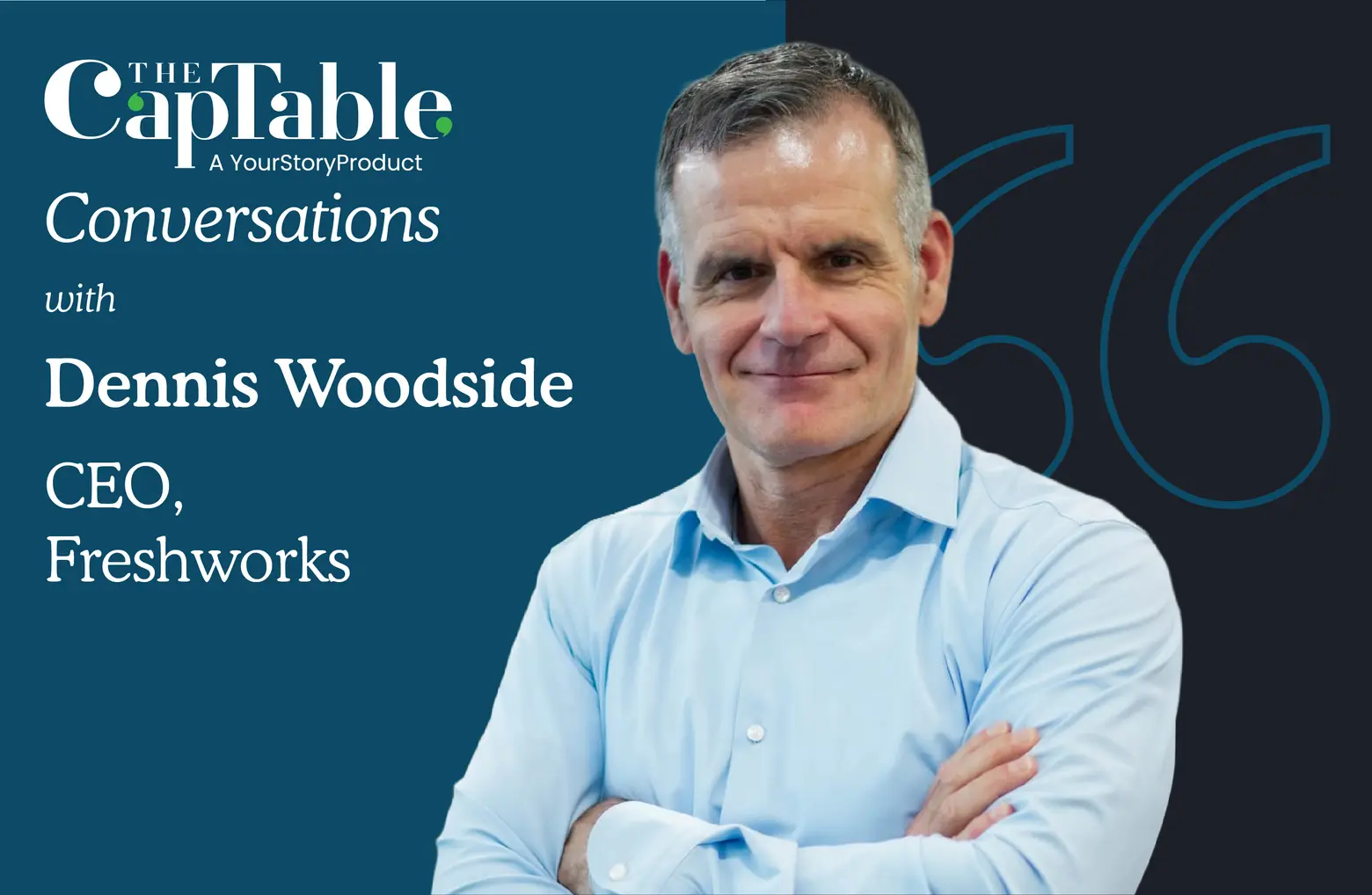
Dennis Woodside has built his career walking into companies just as the ground beneath them shifts. He joined Google when the internet was still young, became chief executive of Motorola Mobility right as smartphones became ubiquitous, and later served as chief operating officer of Dropbox as the wider market shifted away from on-premise storage toward the cloud. In May 2024, he became chief executive of Freshworks, the Chennai-born, Nasdaq-listed software company, succeeding founder Girish Mathrubootham.
The backdrop to this conversation is the upheaval that swept through enterprise software earlier this year. In February, a single trading session wiped out roughly $285 billion in market value from software and SaaS companies worldwide, the sharpest single-day correction the sector has seen, triggered by Anthropic’s launch of plugins for Claude Cowork and the sudden realisation among investors that AI agents could do the work of several human users at once. If 10 employees can effectively be replaced by one AI agent, the logic went, a company no longer needs 10 software seats, and the per-seat pricing model that has underwritten the SaaS industry for two decades suddenly looked shakier than anyone had priced in.
Hyperscalers, meanwhile, are pouring an estimated $650 billion into AI infrastructure this year alone, a figure Woodside cites readily. It is a backdrop that would unsettle most companies built on selling software by the seat, but Woodside treats it less as a threat than an opening, betting that the businesses which actually use enterprise software, not the financial markets reacting to it, will decide how the next chapter of SaaS gets written.
Woodside calls this the biggest external technology transition he has experienced in three decades. In this conversation with Jarshad NK, The CapTable’s Editor-in-Chief, he explains why Freshworks rebuilt its entire product development process around AI in seven months, and why the company is now mixing consumption-based pricing alongside the traditional seat licence.
“Everybody’s a builder now,” he says, describing how his own employees, with no coding background, are building their own AI tools, much like he has built his own Ironman training plan using Claude. Through it all, his message stays consistent: software is not dying, it is simply being rebuilt from the inside out, and for him, that is reason for optimism, not alarm.
Edited excerpts:
Dennis Woodside: That’s a good question, and the short answer is we’ll have to see. If you think about what’s going on globally, the hyperscalers are going to invest $650 billion in capex, data centres, and chips this year. Morgan Stanley projects that to be a trillion next year, and (there are predictions that it would be) $8 trillion over the next five years. So there are some very smart people financing that investment, and the expectation is that there’s going to be a return. What it all comes down to is how real customers actually get value from software.
We have 75,000 customers, including businesses like Asian Paints, which is a real business that has to deliver a real product. They need to see real results from any AI they use, and that AI has to fit within their existing business. They’re going to look to AI to improve how they support their customers and their employees. If there’s real, tangible value they can point to, either their employees get more productive and can drive revenue faster, or they can operate more efficiently at a lower cost, then the whole thing works.
But it’s so early that it’s very hard to say how that equation plays out. How does the industry get a return on $8 trillion in capital that's never been spent before? I think software has an integral role to play in the delivery of AI. Most companies are going to look to their existing software providers for AI capability. Historically, software has provided deterministic answers, where if I do A and B, C always happens. If I’m a new employee at Asian Paints, I get access to Okta, then Microsoft, then a computer, in that order, with certain approvals, every single time. The company doesn’t want to leave that to chance. AI can fill in the spaces when what’s being asked doesn’t follow that kind of linear flow. So software, which has historically been deterministic, is going to live right alongside AI. And as AI succeeds, the software industry is going to succeed too, because the two go hand in hand.
Dennis Woodside: It completely changes how you build software. We have 4,000 employees, 3,000 of them in India, with roughly 2,000 in Chennai. Nearly all of our engineering and software is written here. In the last seven months, we have completely transformed how we build software. Think about how you actually build a piece of software.
There’s a role called a product manager, whose job is to understand what a customer needs and turn that into what’s historically called a product requirements document, an extensive document covering what the product will do, how it will interact with other software, what it will cost and who the target customers are. That used to take us three to four weeks.
Now, a product manager writes their idea on one page, and we’ve built AI that turns that into the complete documentation, which typically takes a couple of hours instead of a month. That means we can ship a lot faster, and that’s just one part of it. Once we have that product requirements document, we can turn it directly into code, so you’ve gone from an idea in a product manager’s head to real code. The code still has to be checked by people, and there’s a lot of quality control from that point. But it’s a huge step forward in the speed of software delivery, which means we can do more, faster. There’s no limit to the number of ideas and requests we get from customers, we probably have several hundred specific requests from existing customers for improving our software, so AI has completely changed that too.
AI has also changed how customers want to interact with software. They still value the robust software we provide to power an IT department or a customer support department, but they increasingly want their agents to benefit from AI, through what we call a co-pilot that gives agents perfect access to information about the product catalogue or IT catalogue. Take Tata. Both Tata Digital and Tata Consumer Products use us, and their use case is customer support for distributors. A distributor has a question about an order, where is it, or they need to change it, and that’s all handled through our software. Increasingly, AI can handle those questions.
It’s better for the distributor because they can ask questions any time, in any language, and it’s better for Tata because the routine questions no longer need to be handled by their employees. So it transforms how you build software, the software factory looks very different than it did a year ago, and it transforms the relationship you have with the customer, because it’s no longer just about deterministic software, it's about AI that's deeply embedded in it.
Dennis Woodside: Yes, it is. Customers like Asian Paints and Tata want auditability, they want to be able to go back and inspect what happened. Take a big food distributor working with Tata Consumer, they’re going to interact with humans through the customer support team, and that interaction is all documented, so if there’s a problem later, the manager can go back, look at the audit trail and help the distributor out.
AI works the same way. Every AI interaction is recorded, and a manager can go back and inspect it for quality. At the end of every interaction, the AI also asks the distributor whether they were happy with it, and that signal helps make the AI better, because if they say no, it can ask why, and that reinforces the system. So it’s transforming how software is built and the experience customers have, but the systems we’ve built over a decade are still critical, the ability to deliver experiences, provide an audit trail so you can inspect and make sure the AI is doing what you want, and the controls to stop it from hallucinating. All of that is super important, and that’s what our customers look to us for.
Dennis Woodside: Totally, the model is completely changing. Customers still appreciate the certainty that seats give them, so they’d typically contract for, say, 600 seat licences on an annual contract, and they know what the cost is. Now it’s a mix of seats and consumption-based pricing. We price interactions with an AI agent on a session basis, so if one of their customers chats with the AI and gets a problem solved, there’s a variable cost attached to that. You’re going to have variable pricing alongside seats for some time. Some customers want to move to variable pricing faster, others will appreciate the certainty of the fixed model for longer. We need to give them that choice as the model changes.
Dennis Woodside: In my job, it’s important to separate the financial markets from actual customer behaviour. Our customers continued to grow with us, we grew the business 16% last quarter, and the Freshservice business grew 27%.
We’re seeing customers come to us for AI capability, looking for a trusted source they’re already using to run their business. So I never got too worried about whether the market was right and software was going to die, that doesn’t seem plausible to me. But we have to keep executing. I think the more interesting question is what the real threat actually is.
The real challenge for a software company now is that you have to compete at the experience layer in a way we didn’t before. We have a system of record, which holds all the interactions between our customers and their customer service or IT department, and there’s a tremendous amount of knowledge in that. Companies have workflows built into our system that let them actually get work done, onboarding, offboarding, provisioning new software or hardware, all of that is built in. What’s different now is that a layer is being built that runs through Slack or Teams, where employees and customers just want to chat with an AI to get things done. We provide that software today, but startups provide it too, and they can sit on top of our system of record. If they offer a better experience, we lose customers. So we have to compete at that layer in a way we didn’t before, and I'm perfectly fine with that, so is the team here.
The question is whether we can build amazing experience-layer software and AI that delivers for our customers, that’s accurate, auditable, deeply embedded in our systems and knowledge. And that’s what we have in the market. We have over 7,000 customers paying for our AI capability today. We announced a big new product today, AI Agent Studio for the EX product line, which lets customers build agentic experiences, like resetting a password or issuing a laptop automatically, delivered through Slack, Teams or a portal, so no one has to actually go into Freshservice to do it. It comes with 20 out-of-the-box experiences customers can use to get up and running. That’s the experience layer that competes with the startups, and that’s where we are.
Dennis Woodside: Freshservice is our fastest-growing and largest product, it will end the year around $600 million in ARR (annual recurring revenue), and it grew 27% last quarter. A customer like Asian Paints runs its entire IT department on Freshservice. If you’re the CIO of Asian Paints, with 15,000 to 20,000 employees, you have to support all of their IT needs and deliver service efficiently and at a high level, everything from monitoring network and website performance to making sure critical services stay up. Our software does all of that, in addition to delivering employee service, things like needing a new laptop or the Wi-Fi being slow. That’s what our software does for a company like Asian Paints.
Dennis Woodside: I think the decision I made two years ago, when I became CEO, was to focus on Freshservice as the product that’s the growth engine, and secondly, to make sure we had world-class AI capability. Those have been the defining characteristics of the last couple of years. Now we’re also investing in the customer support business, in particular getting all our customers onto the new, improved version of Freshdesk, and I think that business holds tremendous promise too.
Dennis Woodside: On the service side, definitely, yeah.
Dennis Woodside: We haven’t seen that. It’s very hard to replicate the deterministic workflows needed in a customer support team or an IT team. The IT team wants certain workflows to happen the same way every single time, and workflow software, which is deterministic, lets them do that.
It’s also free once you've deployed it, you’re not paying for tokens. If the workflow is, step one, provide Okta access, step two, provide the laptop, AI doesn’t need to do that, and if you had AI do it, the risk is it doesn’t do it the same way every time, and it’s going to cost you.

In addition, access 50+ archived articles and 3 new articles every month
Sign In
Got a tip? If you have a lead we should be chasing at The CapTable, write to us at [email protected]
Join our community of 100,000+ top executives, VCs, entrepreneurs, and brightest student minds





Blume Ventures

The CapTable brings a refreshing set of insights for us at the Blume team, highlighting stories that bring together the underlying business and founders with that of investors' journeys with these startups. It's an important perspective that very few bring to startup ecosystem enthusiasts.

Convinced that The Captable stories and insights
will give you the edge?
Convinced that The Captable stories
and insights will give you the edge?
Subscribe Now
Sign Up Now